
| 일 | 월 | 화 | 수 | 목 | 금 | 토 |
|---|---|---|---|---|---|---|
| 1 | 2 | 3 | 4 | 5 | 6 | |
| 7 | 8 | 9 | 10 | 11 | 12 | 13 |
| 14 | 15 | 16 | 17 | 18 | 19 | 20 |
| 21 | 22 | 23 | 24 | 25 | 26 | 27 |
| 28 | 29 | 30 | 31 |
- java
- Dependency Injection
- Volatile
- synchronized
- 일급 컬렉션
- Google OAuth
- spring security
- lombok
- factory
- OAuth 2.0
- builder
- 일급 객체
- Spring
- Today
- Total
HJW's IT Blog
CPU Schduling: 본문
CPU Schduling
> 5 State Transition
> Ready-Queue에 있는 프로세스 선택 -> CPU에 올린다
> 모든 프로세스가 메모리에 올라가 있다고 가정, 실행 중인 프로세스는 CPU에 올라가있다 가정
> Multiprogramming 에서 필수적(CPU utilization)
> Non-Preemptive Scheduling
> 프로세스가 "Terminated" 일때 다음 프로세스 실행
> 프로세스가 "Running" 에서 "Blocked" 되었을 때 실행
> 프로세스 우선순위가 더 높은 프로세스가 있다 하더라도 현제 프로세스가 종료가 되어야 함
> CPU Scheduling Goals
> CPU 가 결정하는 사항
> 프로세스가 얼마나 실행될 지
> 어떤 순서로 프로세스가 실행될 지
> User-Oriented Policy
> Average Response Time(요청시부터 프로세스 시작까지) 을 최소화 하고 number of interactive users 를 최대로
> Turnaround Time 최소화 (프로세스 실행부터 완료까지)
> Variance of Average Response Time 최소화
> 예측을 해야 한다
> System-oriented Policy
> Throughput(처리율) 최대화
> Processor Utilization(CPU가 얼마나 사용되는가) 최대화
> Other System-Oriented Policy
> Fairness: 모든 프로세스는 동일하게 취급 (starvation이 일어나서는 안된다)
> Balance Resources: 시스템의 모든 자원이 쉬지 않도록 (최대한)
> Preemptive vs. Non-Preemptive
> Non-Preemptive Executes when
> Process terminated
> Process switches from running to blocked
> Preemptive Executes when
> Process 가 생성 되었을 때
> Blocked 에서 ready 되었을 때
> Timer interrupt 발생
> Preemptive 방식은...
> 오버해드가 더 크지만 긴 프로세스가 CPU 독점 하는 것을 방지
> Syscall 을 처리할 때 OS kernel을 선점 x
Process Execution Behavior
> 다음 사항들을 가정한다
> One process per user
> One thread per process
> 각 프로세스는 독립적이며 자원을 할당 받으려 함(compete)
> 프로세스는 CPU 내부에서 실행(I/O burst cycle)
> 입출력을 해야 계산이 가능하기 때문에 CPU burst - I/O burst를 반복한다
> 프로세스의 두 종류
> CPU-bound: I/O를 적게 수행, 많은 계산 ( long CPU burst)
> I/O-bound: I/O를 많이 수행, 적은 계산 (short CPU burst)
First-Come-First-Served(FCFS)
> Run until done
> Ready-Queue에 있는 프로세스중 non-preemptively 하게 먼저 온 순서로 선택
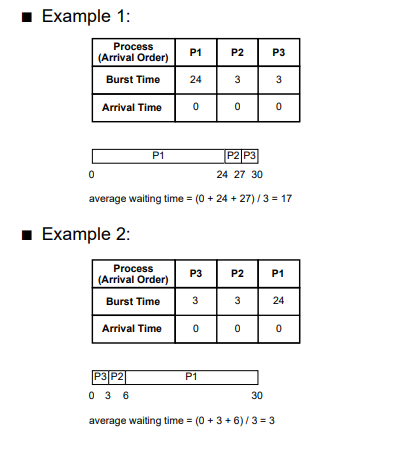
> FCFS Eval
> Non-Preemptive 하다
> Response time 이 느리다
> 긴 프로세스 이후 짧은 프로세스들이 온다면 짧은 프로세스들은 대기 시간이 길다
> 하나의 CPU-bound 프로세스 이후에 많은 I/O-bound 프로세스들이 온다면 "convoy effect"
> Low CPU, I/O utilization
> Throughput: 최대화 x
> Fairness: 짧은 프로세스, I/O-bound 프로세스에 페널티 부여
> Starvation: 불가능
> Overhead: 최소화
Round-Robin
> 정해진 time slice 가 있다
> Ready Queue에 가장 최상위에 있는 프로세스 선택
> 선택한 프로세스를 최대 하나의 time slice 동안 돌리고 완료되지 않을 시, ready queue 로 보낸다.
> 선택한 프로세스가 time slice가 끝나기 전, terminate 되거나 blocked 된다면, ready queue에 head에 있는 다른 프로세스 선택
> 하드웨어 타이머, FIFO ready queue

> RR Eval
> Preemptive 하다
> Response time: Good for short process
> Throughput: Time slice에 의해 결정됨
> Too small: Too many context switch
> Too large: Approximates FCFS
> Fairness: Penalizes I/O-bound processes
> Starvation: Not possible
> Overhead: Low (다음 프로세스 선택에 고민 x)
Shortest-Job-First(SJF)
> 가장 짧은 CPU-burst를 가지고 있는 프로세스를 선택, non-preemptively 하게 프로세스 실행
> Tie 일 경우, FCFS를 사용
> 다음 CPU-burst를 결정하는데 어려움

> SJF Evaluation
> Non-Preemptive
> Response Time: Good for short processes
> Long Processes may have to wait until large number of short processes finish
> Probably optimal: Avg waiting time 최소화
> Throughput: high
> Fairness: Penelizes long processes
> Starvation: Possible for long processes
> Overhead: can be high
Shortest Remaining Time (SRT)
> Preemptive version of SJF
> 다음 smallest CPU burst 를 가지고 있는 프로세스 선택
> Until termination or blocking
> until a process enters that the ready queue
> At that point, choose another process to run if one has a smaller expectd CPU burst than what is left of the current process' CPU burst

> SRT Eval
> Preemptive
> Response Time: Good, Probably optimal
> Throughput: High
> Fairness: Penalizes long processes
> Starvation: Possible for long processes
> Overhead: can be high
Priority Scheduling
> Externally defined: based on importance, money, politics
> Internally defined: based on mem, requirements, file requirements, CPU req vs. I/O req
> SJF is priority scheduling
> Choose the process that has the highest priority and run that processes either
> preemptively or non-preemptively
Eval
> Starvation: possible for low priority processes
> Avoided by Aging: increase priority as they spend time in system